By Bill Howard, US Office Solutions · Central Florida copier & printer specialists · Published August 24, 2026
Most of the “we’re stuck” calls we field start the same way. The copier still runs, but the business outgrew it, the color clicks got expensive, or the service stopped showing up, and now that 60-month agreement feels like a ball and chain. The bad news is that copier leases are built to be hard to break. The good news is that “hard” is not “impossible,” and once you know how the contract is wired, you can pick the exit that costs you the least. Here is how we walk Central Florida businesses through it.
Can you actually get out of a copier lease early?
Yes, but rarely for free, and understanding why is the whole game. Almost every commercial copier lease is written as a finance lease, not a rental. Under Florida’s version of the Uniform Commercial Code (Chapter 680, Florida’s UCC Article 2A), once you accept the equipment your promises under a finance lease become “irrevocable and independent.” In plain English, that is the “hell or high water” clause: you owe every remaining payment even if the machine breaks, even if the vendor disappears, even if your business closes that department.
That is why “the copier jams twice a week” is not, by itself, a way out. The lease and the service contract are usually two separate agreements, and the finance company that owns the paper often has nothing to do with the local tech who is supposed to fix your machine. Knowing that distinction is what keeps you from wasting three months arguing with the wrong company.
First, find your auto-renewal notice window (this is the clause that traps people)
Before you calculate a single buyout number, dig out the contract and find the renewal language. This is the cheapest possible exit and the one most businesses miss.
Copier leases commonly run 36, 48, or 60 months, and a large share of them carry an automatic-renewal (or “evergreen”) clause. To stop the renewal, you have to send written notice inside a specific window, often 30 to 180 days before the end date, with 90 days being the most common. Miss it by a day and the agreement quietly rolls over, sometimes for another full 12 months, at the same payment. We have seen businesses pay a full extra year for a machine they were done with, purely because nobody calendared a notice date buried on page four.
The four real ways out of a copier lease, ranked by cost
Once the free exit (the notice window) is off the table, four routes remain. Here they are cheapest to most expensive, with what each one actually involves.
| Route | How it works | Typical cost | Best when |
|---|---|---|---|
| Exit for breach | You prove the lessor failed a written obligation and terminate for cause | $0 if it holds up, but you must document everything | The finance company or service provider clearly broke the contract |
| Transfer / assignment | Another creditworthy business assumes your remaining payments | Low: often just a transfer or paperwork fee, if the lessor allows it | You can find a taker and the contract has an assumption clause |
| Buyout | You pay a lump sum to end the lease early | Highest: roughly the sum of remaining payments, sometimes plus a residual or termination fee | You need out fast and can absorb the cost |
| Roll into a new lease | A new provider “pays off” your old balance and folds it into a new agreement | Hidden: the old balance is buried in higher new payments | You genuinely need new equipment anyway and the total math still works |
The one route to be careful with
Rolling your balance into a new lease is the route salespeople push hardest, because it feels like a clean escape. It isn’t erasing the debt; you are refinancing it into a bigger, longer agreement. Sometimes that is the right call. Often it is how a business ends up paying for two copiers at once. Run the total, not the monthly.
What a copier lease buyout actually costs
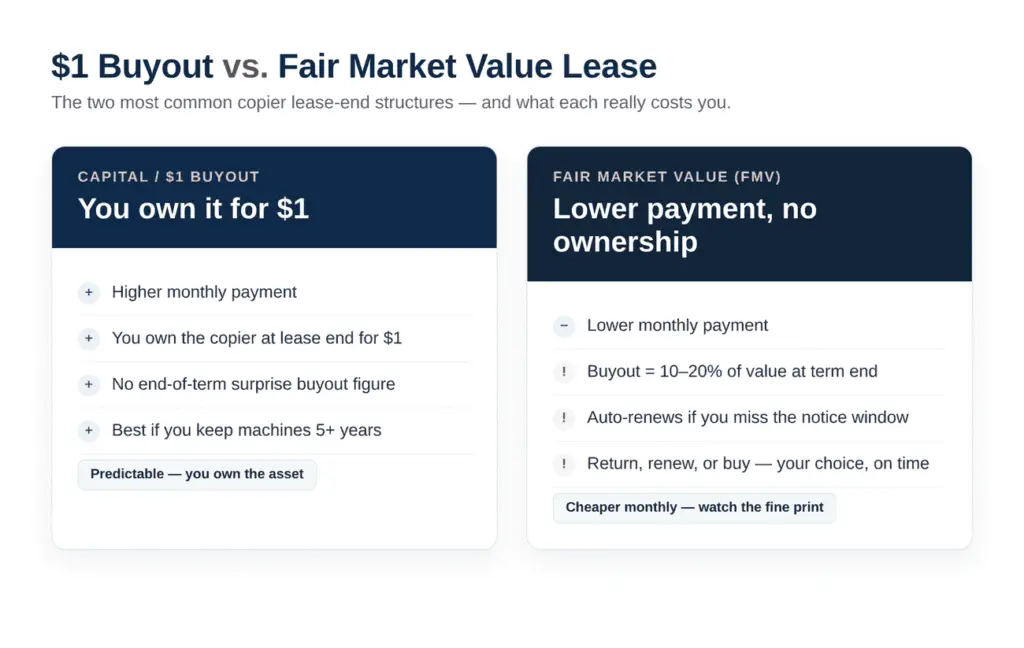
A buyout is the most direct exit, so know the math before you call. In most cases the buyout figure is the sum of your remaining payments, and on a fair market value lease it can also include the equipment’s residual value or an early-termination fee.
Here is a worked example. Say you signed a 48-month lease at $400 a month and you are 18 months in. You have 30 payments left, so your baseline buyout is about 30 times $400, or $12,000, before any residual or fee. That number is your anchor for negotiating, and there is room to negotiate, because the leasing company would frequently rather sell you an upgraded machine on a new lease than chase the full balance. Get every buyout quote in writing, and confirm exactly what it includes: remaining payments only, or payments plus residual, plus any return shipping and de-installation.
One more Florida-specific reality: because of that hell-or-high-water structure, the finance company is not legally obligated to give you a discount. Any reduction you get is a business decision on their side, which means your leverage is the promise of new business, not a threat to walk.
How to avoid getting trapped next time
Whether you get out now or ride this one out, set up the next agreement so you are never in this spot again. A few rules we give every client:
- Negotiate shorter terms. A 60-month lease has a lower monthly payment, but a 36-month term gives you room to adapt as your needs change.
- Separate service from finance. Keep service and supplies on a separate, cancelable agreement, so a service problem does not require you to break a finance lease.
- Kill the evergreen clause up front. Strike or shorten the auto-renewal clause before you sign, and get the buyout formula written into the contract in plain numbers.
- Read the return conditions on any fair market value lease so you are not hit with wear-and-tear charges at the end.
If you would rather have someone read the fine print with you, that is exactly the kind of thing we do for businesses across copier leasing in Orlando. And if you just want a clean number to compare against your current deal, you can get a straight-shooting quote with no evergreen games. It also helps to know, going in, what’s actually in a copier lease agreement and how leasing versus buying a copier pencils out over the full term.
Key takeaways
- Most copier leases are non-cancelable finance leases under Florida’s UCC Article 2A, so “just stop paying” is not an option.
- Your cheapest exit is catching the auto-renewal notice window, often 90 days before the end date, so find that date first.
- Your four routes, cheapest to most expensive: exit for breach, transfer the lease, buy it out, or roll it into a new agreement.
- A buyout is roughly your remaining payments; get it in writing and negotiate with the promise of new business.
- Set up your next lease with shorter terms, separated service, and no evergreen clause.
Frequently asked questions
Can I just stop paying my copier lease?
No. Because a copier lease is almost always a non-cancelable finance lease, stopping payment is a default that can trigger the full remaining balance plus fees and a hit to your business credit. Every real exit runs through the leasing company, not around it.
How much does it cost to break a copier lease?
Usually the sum of your remaining payments, and sometimes a residual value or early-termination fee on top. On a lease with 30 payments left at $400 a month, that’s about $12,000 as a starting point, a figure you can often negotiate down if you’re taking new equipment.
What is a copier lease auto-renewal or evergreen clause?
It’s a clause that automatically renews your lease, often for another 12 months, unless you send written notice inside a set window, commonly 30 to 180 days before the end date. It’s the single most common reason businesses stay stuck longer than they meant to.
Can I transfer my copier lease to someone else?
Often yes, if your contract has an assumption clause and the leasing company approves the new party’s credit. A transfer is usually the lowest-cost real exit because another business takes over the remaining payments, but get the release in writing so you’re not still on the hook.
Can I get out of a copier lease without penalty?
Only in two situations: you’re still inside the auto-renewal notice window, or the leasing company genuinely breached the contract and you can document it. “The machine is slow” rarely qualifies; a documented failure to meet a written obligation might.
Does returning the copier end the lease?
No. Shipping the machine back does not cancel a finance lease. You still owe the payments unless you’ve arranged a buyout, transfer, or approved termination. Return logistics are a separate step that happens after the lease is actually resolved.
Should I roll my old lease into a new one?
Only if you truly need new equipment and the total cost still makes sense. Rolling the balance in doesn’t erase it; it refinances the old debt into a bigger new agreement. Always compare the full lifetime cost, not just the new monthly payment.
Stuck in a copier lease that stopped making sense? We’ll read the fine print with you and give you a straight number to compare against.
Get a straight-shooting quoteBill writes on copier and printer leasing for US Office Solutions in Orlando and Central Florida, where the team places, services, and reads the fine print on office equipment leases every week. He focuses on getting businesses into the right equipment on fair terms, and out of the wrong lease with the least damage.
This article is general information for Florida businesses, not legal advice. Have your attorney or CPA review your specific contract before you act on any exit.