An office copier lease agreement is almost always two contracts, not one: a non-cancelable finance lease with a third-party leasing company, and a separate per-page service agreement with the dealer. The four clauses that cost Florida businesses the most are the annual escalation, the automatic renewal, the fair-market-value buyout, and the county tangible personal property tax that gets passed through to you. Read those four before you sign anything.
Most people sign a copier lease the way they sign a car rental — skim it, initial it, get the machine delivered. Then two years later the payment has crept up, the “return” they assumed was free turns into a fair-market buyout, and a cancellation letter they sent 45 days out gets rejected because the fine print wanted 90. None of that is a scam. It’s all in the agreement. Here is what each part of that agreement actually says, and where the traps sit.
You’re signing two contracts, not one
This is the single most misunderstood thing about copier leasing, and almost no national blog says it plainly: the paper you sign is usually a bundle of two separate agreements.
The first is the lease — a finance contract, most often with a third-party leasing company (DLL, GreatAmerica, US Bank, Wells Fargo Equipment Finance, and similar), not with the dealer who sold you the copier. The dealer sells the machine to the leasing company; the leasing company rents it to you. That is why your monthly payment often goes to a name you have never heard of.
The second is the service and supplies agreement — the maintenance, toner, parts, and repair coverage — and that one is with the dealer. It is priced separately, usually per page.
Why this matters: the lease is non-cancelable and the service agreement is not the lease. If the copier breaks and the dealer stops answering the phone, you still owe the leasing company every remaining payment. Your remedy for bad service is against the dealer, not the finance company. Separating who owes what is the whole game — and it’s written into which signature line is which. Ask who provides your copier service and maintenance and confirm it’s a local team, not a call center.
The term: 36, 48, or 60 months
Copier leases run in fixed terms — commonly 36, 48, or 60 months, with 60 months (five years) being the most common because it produces the lowest monthly payment. Longer terms feel cheaper each month and cost more overall, and they lock you to a machine that may be outdated by year four. The term is also the clock that every other dangerous clause runs on, especially renewal-notice windows. Know your end date the day you sign it.
The buyout: $1 vs. fair market value (this decides if you ever own the copier)
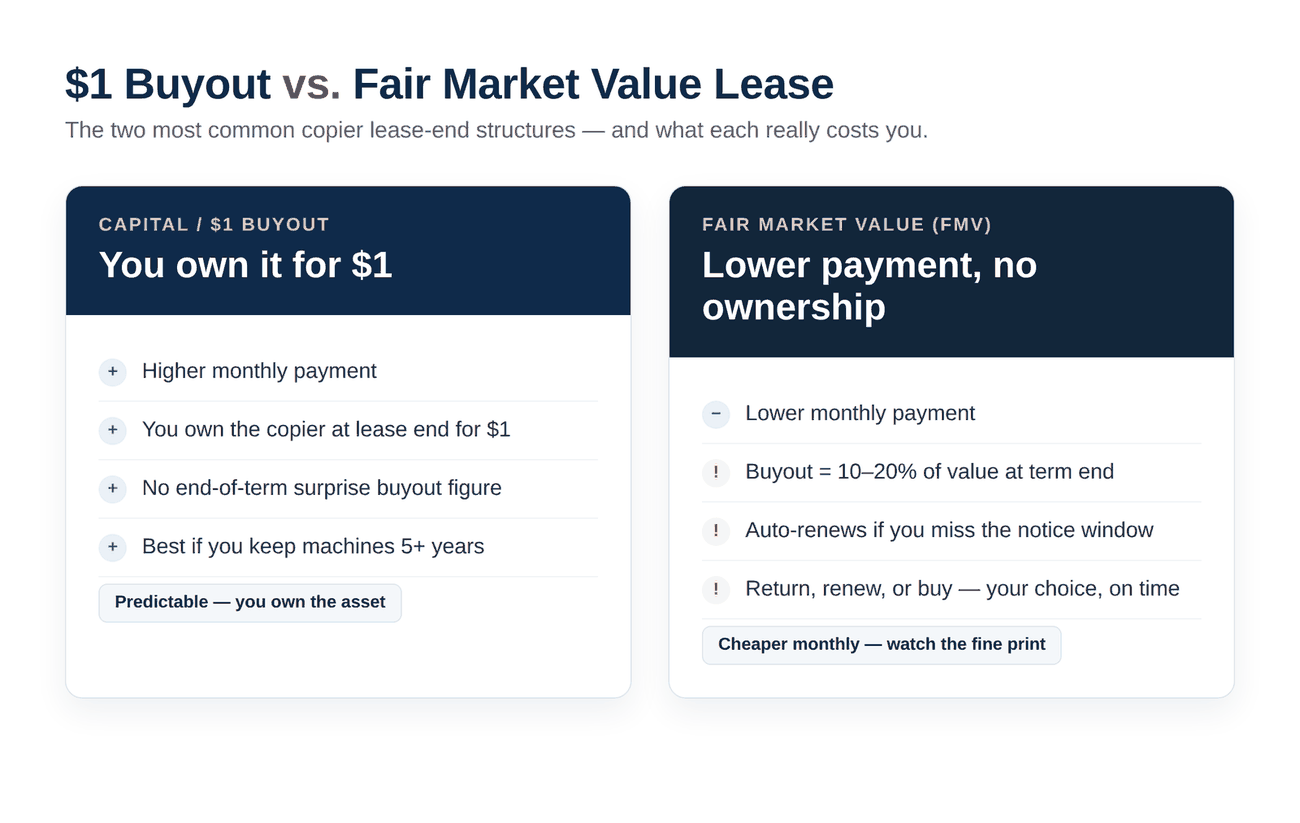
At the end of the term, what happens to the machine is decided by one line: the buyout, or “purchase option.” There are two structures, and they are wildly different.
| $1 buyout (capital lease) | Fair market value (FMV) | |
|---|---|---|
| End of term | You own the copier for $1 | Buy at market price, return it, or renew |
| Monthly payment | Higher | Lower |
| Typical buyout cost | $1 | ~10–20% of original price |
| Best for | Keeping equipment long-term | Refreshing to new tech every few years |
Neither is wrong. A $1 buyout suits a business that wants to keep equipment; FMV suits one that wants to refresh to new technology every few years. What is wrong is not knowing which one you signed. FMV payments are lower, which is why dealers quote them — but “lower payment” is not “cheaper” if you assumed you’d keep the machine and end up buying it twice. Ask the question in writing before the term, not after. (For the full monthly math, see what a copier lease actually costs each month.)
The escalation clause: the increase most people never see coming
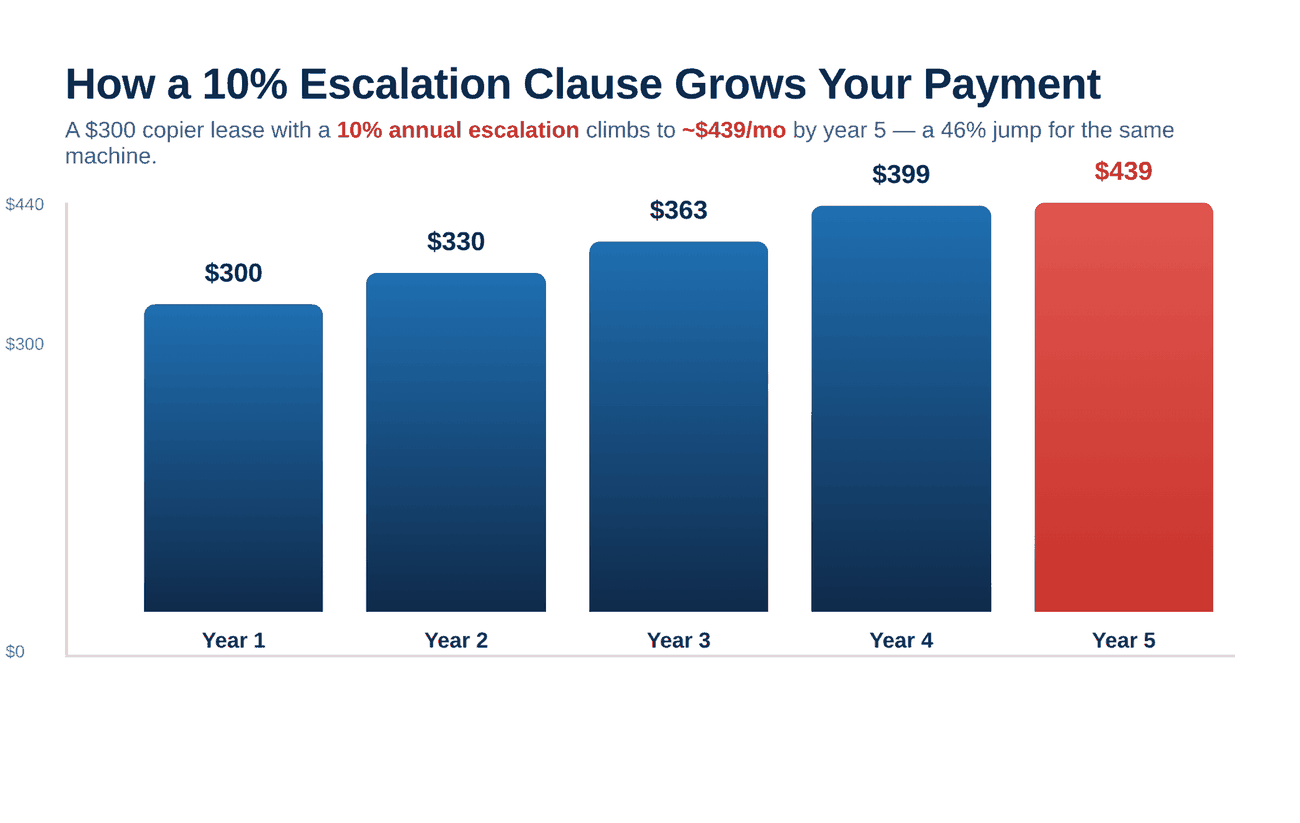
Many equipment leases contain an escalation clause that lets the payment rise on a schedule — commonly up to around 10% per year, though some cap it lower and some don’t cap it at all. It’s often buried in a single sentence and framed as covering “increased costs.”
The math is brutal over five years. A payment that starts at $300/month and escalates 10% annually is roughly $439/month by year five — about a 46% increase over where you started, none of it tied to using the machine more. If you find an escalation clause, negotiate a cap (5% is defensible) or a flat, fixed payment for the full term. A reputable local dealer will write a fixed payment; the ones who hide behind national finance paper are the ones who won’t.
Cost-per-copy and overage: the part of the bill that moves
Your service agreement usually includes a monthly page allotment — a set number of black-and-white and color pages — with everything over that billed as overage. Typical overage rates run around a penny to a penny-and-a-half per black-and-white page and roughly 6 to 9 cents per color page, but the numbers matter less than the structure: color costs multiples of black-and-white, and unmonitored color printing is where “predictable” monthly bills stop being predictable.
Two honest questions settle it. First, what is the included volume, and does it match what your office actually prints (ask for a meter-read history)? Second, what happens to unused pages — do they roll over, or do you lose them? Get both answers before you sign, because this is the line item that changes every month. This is also where a managed print and service plan earns its keep — it’s the difference between a flat, forecastable bill and a surprise.
The automatic renewal (“evergreen”) clause: the one that traps you
At the end of the term, some leases don’t simply end. An automatic renewal, or “evergreen,” clause renews the lease — often for another 12 months — unless you send written cancellation inside a specific notice window, commonly 60 to 90 days before the term ends. Miss the window by a day and you’re legally on the hook for another year on a five-year-old machine.
This clause generates the most surprise invoices in the entire industry. Two defenses: (1) the day you sign, put the notice deadline in your own calendar, counting backward from the end date; and (2) send the cancellation letter by certified mail or a method that produces a receipt — “we never got it” is a real dispute.
The Florida part national blogs skip: taxes and “hell or high water”
Here is where a Central Florida copier lease differs from a generic one, and where out-of-state dealer blogs are no help.
Tangible personal property tax
In Florida, leased business equipment is taxable tangible personal property, and someone has to file a return (Form DR-405) with the county property appraiser and pay the annual tax. On most FMV/finance leases the leasing company owns the equipment and files, then passes the tax straight through to you as a line item — so a “tax” you never budgeted for appears on your invoice. Ask up front who files and who pays, and get it in writing. (See the Florida Department of Revenue’s tangible personal property guidance; Orange, Seminole, and Osceola county property appraisers each publish their own filing details.)
Sales tax on the payments
Florida charges sales tax on the lease or rental of tangible personal property, so your monthly copier payment is taxed as you go — it should be stated on the invoice, not sprung on you.
“Hell or high water”
Most commercial copier leases are finance leases under Florida’s version of UCC Article 2A (Fla. Stat. Chapter 680). A finance lease carries what lawyers call a “hell or high water” clause: your obligation to pay the finance company is absolute and independent of whether the equipment works. If the copier fails, you keep paying the lease and pursue the dealer under the separate service agreement. That is exactly why the two-contracts point at the top matters so much — the law treats them as two separate promises, and so should you.
A five-minute pre-signature checklist
Before you sign an office copier lease in Florida, get answers, in writing, to these seven questions:
| # | Ask before you sign | The answer you want |
|---|---|---|
| 1 | Who is the lessor (finance company) vs. the servicing dealer? | Clearly named; you know who to call for what |
| 2 | Is the buyout $1 or fair market value? | Whichever matches your plan to keep or refresh |
| 3 | Is the payment fixed, or is there an escalation clause? | Fixed for the full term (or a 5% cap) |
| 4 | What’s the included page volume and the overage rates? | Volume matches your real meter reads |
| 5 | Is there an auto-renewal clause, and how many days’ notice cancels it? | A window you can realistically hit |
| 6 | Who files/pays the Florida tangible personal property tax? | Stated in writing; sales tax shown on invoice |
| 7 | What are total payments over the full term (payment × months)? | A number, not just the monthly figure |
If the salesperson can answer all seven without checking, you’re probably dealing with a straight shooter. If they get vague on escalation, renewal, or the buyout, that vagueness is your answer. Still weighing the bigger decision? Here’s whether leasing or buying is right for your business.
- A copier lease is two contracts — a non-cancelable finance lease and a separate dealer service agreement. Know which signature is which.
- The buyout line ($1 vs. fair market value) decides whether you ever own the machine. Confirm it in writing before term end.
- Escalation and auto-renewal clauses cause the most surprise costs — negotiate a fixed payment and calendar the cancellation deadline.
- In Florida, ask who files and pays the tangible personal property tax, and remember finance leases are “hell or high water.”
- Get total-payments-over-term and overage rates before you sign — see office copier leasing in Orlando.
Frequently asked questions
Can you get out of a copier lease early?
Usually only by buying out the remaining payments — most copier leases are non-cancelable finance contracts, so “returning” the machine doesn’t end the obligation. Some businesses roll the remaining balance into a new lease, but that just moves the cost forward. The clean exits are at the natural end of term, or if the dealer will negotiate a buyout, so always check the early-termination language before signing.
What’s the difference between a $1 buyout and an FMV copier lease?
With a $1 buyout (a capital lease), you own the copier for one dollar at the end of the term, and monthly payments are higher. With a fair market value (FMV) lease, payments are lower but you don’t own anything unless you buy the machine at its market price at term end — often 10–20% of the original cost — or you return or renew it. Pick $1 if you want to keep the equipment; pick FMV if you plan to upgrade every few years.
Why does my copier lease payment go up every year?
Almost always an escalation clause — a line in the lease that lets the payment rise on a schedule, commonly up to about 10% per year. It’s legal and it’s in the contract you signed. Going forward, ask for a fixed payment for the full term or a hard cap (5% is reasonable), and get the fixed number in writing before you sign.
Do I have to pay property tax on a leased copier in Florida?
Leased business equipment is taxable tangible personal property in Florida. On most finance/FMV leases the leasing company owns the copier and files the return with the county property appraiser, then passes the tax through to you as a line item on your invoice. Ask, in writing, who files and who pays before you sign — and note that Florida sales tax also applies to the monthly lease payment itself.
What happens if I miss the cancellation window on my copier lease?
If the lease has an automatic-renewal (“evergreen”) clause and you miss the notice window — commonly 60 to 90 days before term end — the lease renews, often for another 12 months, and you owe those payments. The fix is preventive: the day you sign, calendar the cancellation deadline counting backward from the end date, and send your cancellation by certified mail so you have proof it arrived.
Is the copier lease the same contract as the service agreement?
No — and treating them as one is the most expensive mistake in copier leasing. The lease is a finance contract with a leasing company; the service and supplies agreement is with the dealer and is priced per page. If the machine breaks, you still owe the lease company under the “hell or high water” rule, and your remedy for the breakdown is against the dealer’s service agreement. Keep the two straight.

Bill Howard
Copier & Printer Specialist — US Office Solutions, Orlando FL
US Office Solutions leases, services, and supports office copiers and multifunction printers for businesses across Orlando and Central Florida.
Want a copier lease with no surprises?
We write fixed payments, name the buyout up front, and service every machine locally. Get a plain-English quote for office copier leasing in Orlando & Central Florida.
See leasing optionsSources: Florida Dept. of Revenue — Tangible Personal Property · FindLaw — UCC Article 2A · Fla. Stat. Chapter 680 (Leases). Overage, escalation, and buyout ranges are industry-typical figures; your agreement’s numbers govern.