By Bill Howard, US Office Solutions · Central Florida copier & printer specialists
Published September 28, 2026 · 8-minute read
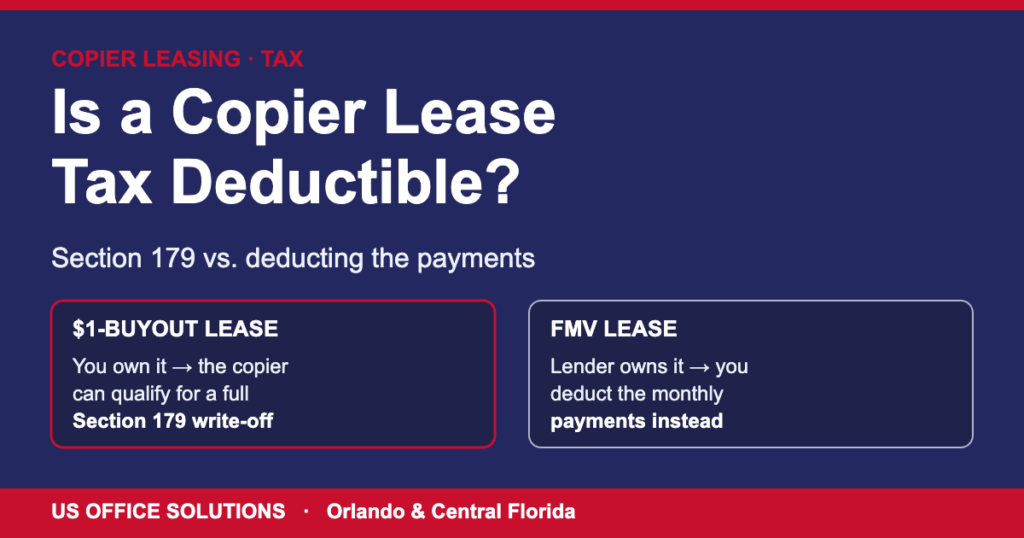
Yes, a copier lease is tax deductible — but how you deduct it, and how big the write-off is in the first year, gets decided the day you pick your lease structure, not at tax time. A $1-buyout (capital) lease is treated as a purchase, so the copier itself can qualify for a full first-year Section 179 write-off. A fair-market-value (operating) lease isn’t a purchase for tax purposes, so you don’t take Section 179 on the machine; instead you deduct the monthly payments as an ordinary business expense. Either path gives you a deduction — the real question is whether you want it all at once or spread across the term. For 2026, Section 179 lets a business expense up to $2,560,000 of qualifying equipment placed in service by December 31.
I place and service Ricoh, Kyocera, and Epson machines for offices across Orlando and Central Florida, and this is the question that lands in my inbox every October, right about the time owners start thinking about year-end. Here’s how it actually works in plain English, then take the specifics to your CPA.
Is a copier lease tax deductible?
Yes — the IRS lets you recover the cost of business equipment you lease, and a copier used in your business almost always qualifies. What changes with the lease type is the mechanism: a capital ($1-buyout) lease lets you write off the machine itself, while an operating (FMV) lease lets you deduct the payments. Neither one leaves you without a deduction. They just put it on a different line and a different timeline.
Section 179 in one paragraph
Section 179 is the slice of the tax code that lets a business deduct the full cost of qualifying equipment in the year it’s placed in service, instead of depreciating a fraction of it each year for five to seven years. IRS Publication 946 lays out the two rules that matter for a copier: the property has to be “acquired by purchase” and used more than half the time for business, and your total Section 179 deduction can’t be larger than your business’s taxable income for the year, so the excess carries forward. That “acquired by purchase” language is the whole reason your lease structure decides the answer, which is the next section.
The fork that decides everything: $1-buyout vs. FMV lease
The IRS doesn’t care how much you put down; it cares who owns the copier for tax purposes, and your lease structure is what answers that.
A $1-buyout (dollar-out) capital lease treats you as the owner from day one. The copier goes on your books as an asset, and at the end of the term you buy it outright for a dollar. Because you own it for tax purposes, the machine can qualify for Section 179 (or bonus depreciation), and copiers leased this way through a capital lease or finance agreement do qualify, as equipment-finance guidance and copier-specific dealers both spell out. Your monthly payments aren’t separately deductible, because you’re deducting the asset instead.
A fair-market-value (FMV) operating lease keeps ownership with the leasing company; you’re paying for the use of the copier. You can’t take Section 179 on a machine you don’t own, but you can deduct your full monthly lease payment as an ordinary business expense for as long as the lease runs.
| $1-buyout capital lease | FMV operating lease | |
|---|---|---|
| Who owns it for tax purposes | You | The leasing company |
| On your balance sheet | Yes | No |
| End of term | Buy it for $1 | Return it or buy at market value |
| Monthly payment | Higher | Lower |
| Section 179 on the copier | Yes (subject to IRS rules) | No |
| Monthly payments deductible | No (you deduct the asset) | Yes |
Neither structure is “the tax-smart one.” A profitable business that wants a big deduction this year leans toward the $1-buyout; a business protecting cash flow or keeping equipment off its balance sheet may prefer the lower FMV payment and a steady, spread-out deduction. It’s the same $1-versus-FMV decision covered in our guide to copier lease buyout options, and it just has a tax consequence riding on it.
What it looks like on a $12,000 copier
Here’s the difference in real dollars on a mid-range color multifunction — the kind of Ricoh or Kyocera unit a 10-to-30-person Central Florida office typically leases.
Worked example
Illustrative only — your rate, income, and term change the math, so confirm it with your CPA.
- Copier: $12,000, on a $1-buyout capital lease, placed in service by December 31, 2026.
- Section 179 route: deduct the full $12,000 this year. At an assumed 25% effective tax rate, that would be roughly $3,000 less tax for 2026.
- Ordinary depreciation route (no 179): about $1,700 a year over seven years, roughly $425 of first-year tax benefit at the same rate.
- FMV lease route: no Section 179, but you deduct the payments — on a 60-month lease, that’s around $2,900 of payments deducted in the first year.
The takeaway isn’t the exact figure. It’s the shape: the $1-buyout structure front-loads the deduction into year one, while the FMV structure spreads it evenly across the lease. If you’re still deciding whether to lease at all, our breakdown of leasing vs. buying a copier in Florida and what a copier lease actually costs covers the rest of the numbers.
The 2026 Section 179 limits
For the 2026 tax year, a business can expense up to $2,560,000 of qualifying equipment under Section 179, so a copier, or even a small fleet of them, sits far below the ceiling. The deduction phases out dollar-for-dollar once total qualifying purchases pass $4,090,000 and disappears entirely at $6,650,000 (2026 figures via Section179.org), thresholds no small office is going to hit. After the One Big Beautiful Bill Act of 2025, 100% bonus depreciation is back too (Section179.org), which your CPA can layer on after Section 179 if you’re buying more than copiers this year. One limit that does catch small businesses: Section 179 can’t create a loss. The deduction is capped at your taxable income, and anything beyond that carries forward to next year.
Why December 31 is the date that matters
To claim Section 179 for 2026, the copier has to be “placed in service” — installed and actually available to use — by December 31, not merely ordered or signed for. That distinction is where year-end deals go sideways: a machine ordered in mid-December whose install slips into the first week of January counts for next year, not this one. If part of why you’re leasing is the write-off, back your timeline up from December 31 and leave room for delivery, network setup, and a real test print before the year closes.
Where Central Florida offices trip up
The two mistakes I see most around here aren’t about tax law at all. First, owners assume any lease qualifies for Section 179 and only learn at filing that their FMV lease doesn’t — a five-minute question about structure before signing would have caught it. Second, they wait too long. Most of the small-business copier leases we place in Orlando run between about $3,000 and $25,000 and are written as $1-buyout deals, and the ones that miss the deduction miss it on the calendar, not the paperwork.
If the write-off is part of your plan, settle the structure with your CPA first, then let us build the lease around it. It’s also worth knowing exactly what’s in a copier lease agreement before you sign, so the buyout language matches the tax treatment you’re counting on.
Key takeaways
- A copier lease is deductible either way — the structure decides the mechanism, not whether you get a deduction.
- A $1-buyout (capital) lease lets the copier qualify for a full Section 179 write-off; the monthly payments aren’t separately deducted.
- An FMV (operating) lease gives no Section 179 on the machine, but the monthly payments are fully deductible as a business expense.
- The 2026 Section 179 cap is $2,560,000 — a copier is nowhere near it — and the deduction can’t exceed your taxable income.
- “Placed in service” (installed and usable) by December 31 is the real deadline.
- Decide the structure with your CPA before you sign, not at tax time.
Frequently asked questions
Can I write off a copier lease?
Yes. On a $1-buyout lease you write off the copier itself, often in year one through Section 179; on an FMV lease you write off the monthly payments as a business expense.
Does a leased copier qualify for Section 179?
It can — if the lease is a $1-buyout / capital lease or finance agreement, so you’re the owner for tax purposes. A fair-market-value operating lease does not qualify, because the leasing company owns the machine.
What’s the Section 179 limit for 2026?
Up to $2,560,000 of qualifying equipment, phasing out above $4,090,000. A copier is far under the cap.
Do I need to make a profit to use Section 179?
Effectively, yes. Section 179 can’t exceed your business’s taxable income for the year, and any excess carries forward to future years.
Should I take Section 179 or just deduct the payments?
If you want the biggest deduction this year and you’re profitable, the $1-buyout plus Section 179 route front-loads it. If you’d rather protect cash and your balance sheet, an FMV lease spreads a steady deduction. Your CPA weighs it against your income.
When does the copier have to be installed to count for this year?
It has to be placed in service — installed and usable — by December 31 of the tax year you want the deduction in.
Bill Howard · US Office Solutions
Bill writes on copier and printer leasing for US Office Solutions in Orlando and Central Florida, where the team places, services, and reads the fine print on office-equipment leases every week.
Planning a year-end copier?
Want the lease structured so the write-off stays on the table? See copier leasing in Orlando or compare leasing vs. buying.
Request a plain-English quoteThis article is general business information for Florida offices, not tax, legal, or accounting advice. Section 179 rules, limits, and how they apply to your lease depend on your specific situation and can change with new legislation. Confirm the deduction and your lease structure with a qualified CPA or tax advisor before you sign or file.