By Bill Howard, US Office Solutions · Central Florida copier & printer specialists · September 17, 2026 · 8-minute read
A Winter Park marketing agency called us last spring, eight months into business, convinced nobody would lease them a copier. Real clients, real revenue, but no two-year credit file, and a leasing company had already told them no. They had a right-sized color multifunction running in their office that same week. Not because we bent a rule, but because that first “no” almost never means what business owners think it means.
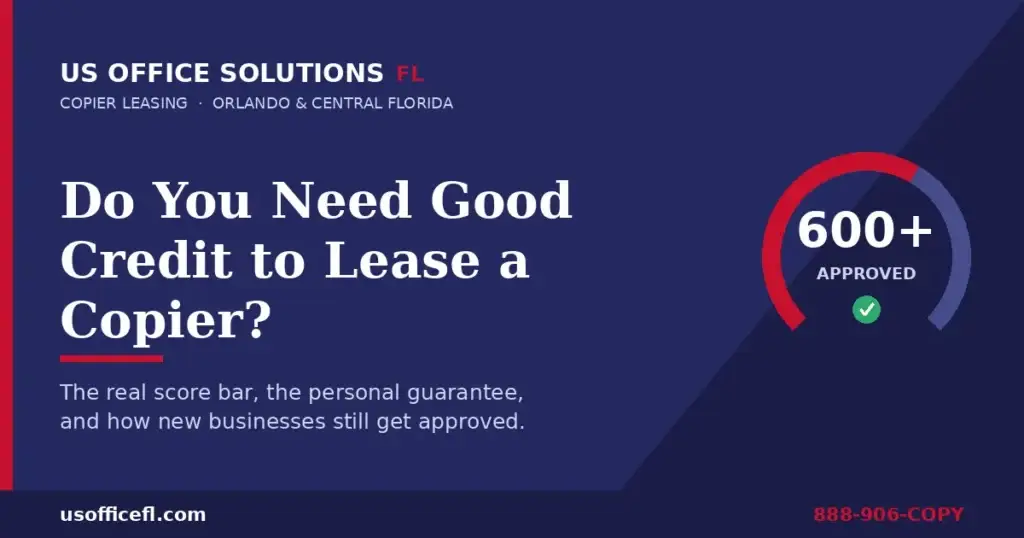
No, you don’t need great credit to lease a copier, but someone attached to the business usually needs decent credit. A company with two or more years of established business credit can often qualify on its own. A newer or thin-file business gets approved on the owner’s personal credit through a personal guarantee, and a personal score in the mid-600s is usually enough. Below that, you still have real options (a specialty lender, a smaller machine, or a short-term rental) that just cost a little more.
I place and service these machines across Orlando and Central Florida, and credit is the part that scares people off before they even ask. Here is exactly how approval works, in plain English.
Do you need good credit to lease a copier?
You need acceptable credit somewhere in the deal, not perfect credit, and not necessarily the business’s credit. Copier leases are underwritten like small equipment loans: the leasing company is betting you will make 36 to 63 monthly payments, so it wants evidence you pay your bills. That evidence can come from the business’s own credit history or from the owner’s personal credit standing behind it. Most approvals I submit for Central Florida offices lean on one or the other, and they rarely need both to be spotless.
Personal credit or business credit: which do they check?
They check whichever one carries the deal, and for most small or newer businesses, that is the owner’s personal credit. An established business with a couple of years of trade lines and a Dun & Bradstreet PAYDEX file can often be approved in the company name alone. But when a business is young, or has never opened credit accounts in its own name (very common, since most founders run everything on a personal card), the leasing company falls back on the owner’s personal credit as the proxy. That is why a brand-new LLC with a great idea still gets asked for a personal guarantee: there is no business track record to read yet.
What credit score do you actually need?
For most copier and equipment leases, underwriters want a personal score in the 600s, and a mid-600s or better clears the large majority of standard approvals. The exact bar shifts by lender, but the published ranges line up closely:
| Personal credit score | What typically happens |
|---|---|
| 700+ | Best rates and fastest approval; least likely to need a personal guarantee on an established business |
| 650–699 | Standard approvals at competitive rates; personal guarantee likely if the business is newer |
| 600–649 | Still very leasable, usually with a personal guarantee and a slightly higher rate |
| Below 600 | Major national lessors often pass; a specialty lender, a smaller machine, or a rental keeps you moving |
For context from the wider equipment-finance world: Crest Capital notes that 650 is the minimum most equipment-financing lenders typically require, Lendzi puts the common bar at 600 to 650, and Experian points out that personal credit matters most when the business is new and has not built its own file yet. So the copier industry is not unusually strict. It uses the same yardstick as equipment finance in general.
The five things a leasing company actually checks
Your score is one input, not the whole decision. When I submit a Central Florida application, here is what the underwriter is really weighing:
- Time in business. Two or more years of documented revenue is the line that flips a deal from “needs a guarantee” to “qualifies on its own.” Count from when the business started reporting revenue, not from when you registered the LLC.
- Business credit history. A D&B PAYDEX score and clean trade lines with other vendors. Thin or missing? The application leans harder on the next two items.
- Personal credit of the owner or guarantor. The mid-600s bar above, used as the fallback when the business file is thin.
- Revenue and bank statements. Three to six months of statements showing steady deposits. A common underwriting rule of thumb is that monthly revenue should run at least ten times the lease payment. Overdrafts and NSF fees hurt here more than a middling score does.
- The equipment itself. The lease is secured by the copier, so a reasonable, right-sized request reads as lower risk. This is the lever owners forget they control.
Can a brand-new business lease a copier?
Yes. New businesses lease copiers constantly, almost always on a personal guarantee. A personal guarantee is a separate promise that you will cover the payments personally if the business cannot. It is how the large majority of startup equipment leases get done, because it gives the leasing company recourse beyond a company with no history. If your personal credit is in the mid-600s and the machine is right-sized for what the business actually needs, that is usually a fair trade for getting equipment now instead of tying up $5,000 to $15,000 in cash buying one outright. Just read what the guarantee covers: some are limited to the remaining payments, while others sweep in late fees, collection costs, and attorney fees. That language lives in the lease agreement, which is worth decoding before you sign.
Can you lease a copier with bad credit?
Usually yes, and the terms just change. A below-average score does not end the conversation; it moves it to a different lane. Four paths keep a credit-challenged business moving:
- Specialty leasing companies. Smaller lessors that write the startup and credit-challenged deals the big national houses decline. Higher rate, but a real “yes.” Nationally, some equipment lenders will approve scores as low as roughly 590 with about two years in business.
- A right-sized machine. Asking for a $3,000 to $5,000 desktop multifunction instead of a $25,000 production unit changes the risk math immediately.
- A cross-corporate guarantee. If you own another, more established business, it can stand behind the lease and keep personal liability off the table.
- Rent instead of lease. A short-term copier rental skips the multi-year underwriting entirely, which is useful while you build business credit, then convert to a lease once you have history.
The thread running through all four: a dealer with relationships across several leasing companies can shop your file instead of treating one lender’s “no” as final.
Will applying hurt my personal credit?
Applying usually triggers one hard inquiry on your personal credit, typically a few points that fade within a year, and the lease itself normally reports on your business credit, not your personal file, as long as you pay on time. The personal guarantee does not move the debt onto your personal report by default; it becomes your personal problem only if the business defaults and the lessor enforces the guarantee. One tip founders miss: ask whether the leasing company reports your on-time payments to Dun & Bradstreet. Many do not unless you ask, and two years of reported, on-time copier payments is exactly the history that gets your next lease approved without a guarantee.
Before you apply: a 6-point checklist
A little prep is the difference between a 24-to-48-hour approval and a week of back-and-forth. Before you submit:
- Pull your personal credit and fix obvious errors; pay down a high-balance card if you can.
- Get a free D-U-N-S number from Dun & Bradstreet so the business has a file to read.
- Gather 3 to 6 months of business bank statements, and keep the recent ones clean of overdrafts.
- Right-size the machine to real volume; do not apply for more copier than the business needs on day one.
- Work with a dealer who uses several leasing sources, not one. Ask how many they submit to.
- Be upfront about your credit so the dealer can pre-qualify you to the lender most likely to say yes.
- You don’t need great credit to lease a copier, but someone in the deal usually needs decent credit, the business’s or the owner’s.
- Established businesses (2+ years, real trade lines) can qualify on their own; newer ones lean on the owner’s personal credit through a personal guarantee.
- A personal score in the mid-600s clears most standard approvals; 600 to 650 is the common industry bar, and some lenders go lower at a higher rate.
- The score isn’t the whole story: time in business, bank statements, revenue (about 10x the payment), and a right-sized machine all move the decision.
- Bad credit rarely means “no”: specialty lenders, a smaller machine, a cross-corporate guarantee, or a rental keep you moving.
- One “no” from one leasing company is not a “no” from the industry.
Frequently asked questions
What credit score do you need to lease a copier?
Most copier and equipment leases look for a personal score in the 600s, with the mid-600s clearing the large majority of standard approvals. Published industry bars sit around 600 to 650, and stronger scores earn better rates.
Do copier leasing companies check personal or business credit?
Either can carry the deal. Established businesses may qualify on business credit alone; newer or thin-file businesses are usually approved on the owner’s personal credit through a personal guarantee.
Do I have to sign a personal guarantee?
Often, if the business is newer. A personal guarantee makes you personally responsible if the business cannot pay. Established businesses with their own credit history can sometimes avoid it, which generally takes about two years in business and a stronger file.
Can I lease a copier with bad credit?
Usually yes, on different terms. Options include specialty leasing companies, a smaller right-sized machine, a cross-corporate guarantee, or a short-term rental while you build business credit.
Can a brand-new business lease a copier?
Yes. Startups lease copiers regularly, almost always on a personal guarantee, with the owner’s personal credit carrying the approval until the business builds its own history.
Does a copier lease show up on my personal credit?
Normally the lease reports on your business credit if you pay on time. It reaches your personal credit mainly if the business defaults and the lessor enforces the personal guarantee. Applying usually adds one hard inquiry to your personal report.
What happens if one leasing company denies me?
Not much. A single underwriter’s “no” is not the industry’s answer. A dealer who works with several leasing companies can re-submit your file elsewhere, including specialty lenders for credit-challenged deals.
Wondering whether you’ll qualify?
We pre-qualify you honestly before anything gets submitted, then shop your application across multiple leasing companies. Look at copier leasing in Orlando, weigh leasing vs. buying and what a copier lease actually costs, or skip ahead.
Request a plain-English lease quoteBill Howard · US Office Solutions
Bill writes on copier and printer leasing for US Office Solutions in Orlando and Central Florida, where the team places, services, and reads the fine print on office equipment leases every week. He focuses on getting businesses into the right equipment on fair terms, and out of the wrong agreement with the least damage.
This article is general business information for Florida offices, not credit, tax, or financial advice. Every leasing company underwrites differently, and your actual terms depend on the lender and your application.